The Legacy of Central State Hospital & Deinstitutionalization
“It has witnessed the heights of man’s humanity and the depths of his degradation. It has done much more good than evil, and yet, there is still more evil than good men and women will wish to continue to tolerate.”
-Dr. Peter G. Cranford on Central State Hospital, in his book But for the Grace of God


The deinstitutionalization movement that began in the 1960s-1970s has received much criticism. 

With the arrival of new psychiatric medications in the mid-1950s, such as chlorpromazine and later clozapine, came new treatment philosophies for care of the mentally ill. The deinstitutionalization movement that started in the 1960s pushed for more community-based mental health centers and treatment for patients, and as a result, the number of inpatients at hospitals like Central State declined rapidly. The number of inpatients peaked in 1955 at 559,000 or 0.3% of the population, according to the findings of Jimmy Carter’s Presidential Commission on Mental Health. On February 17, 1977, Jimmy Carter signed Executive Order 11973, establishing a commission to investigate some of the persistent concerns with institutions like Central State Hospital–overcrowding, lack of sufficient funding/resources, adequate/qualified medical staff, neglect, and abuse, among others.
Deinstitutionalization was also an effort by the federal government to cut budgets, and psychiatric medications coupled with community-based care allowed these budget cuts to take place. In 1980, President Carter signed the Mental Health Services Act, which was intended to provide grants for community mental health centers and was viewed as landmark mental health legislation. President Ronald Reagan subsequently repealed most of the MHSA on August 13, 1981, with the exception of the Patients’ Bill of Rights (section 501). There are both pros and cons to deinstitutionalization. On one hand, community-based care and medication have successfully given more rights to the mentally ill and special needs patients, and it has allowed many people to live productive lives without the abuse and neglect of institutions like Central State Hospital. On the other hand, many argue that deinstitutionalization has resulted in increased homelessness, substance abuse, incarceration, and mass murders.

Georgia’s Behavioral Healthcare Timeline

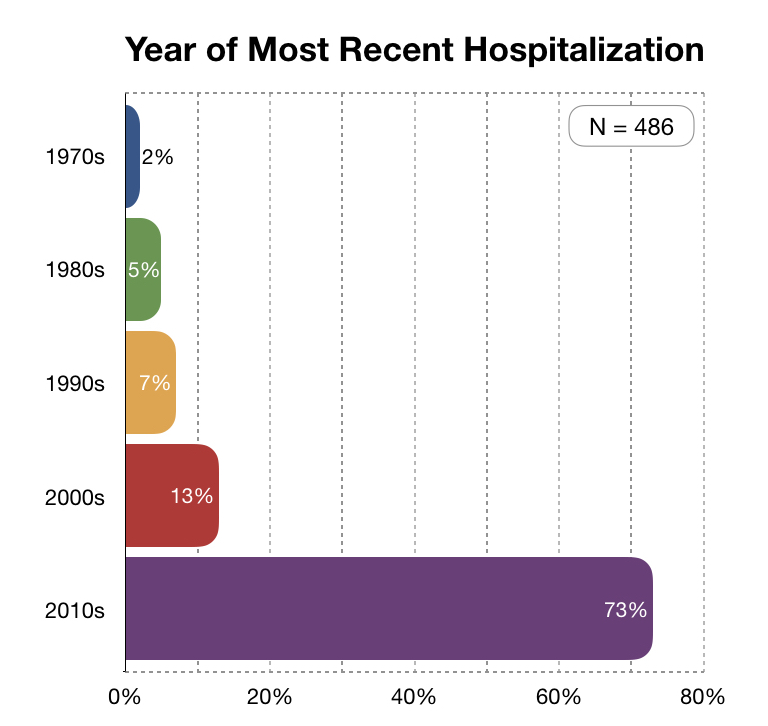
In a 2018 survey conducted by Michael Simonson for Mad in America, the majority of respondents–who had all been hospitalized in a psychiatric hospital at least once–had negative and traumatic experiences, demonstrating that patient abuse and neglect are not merely concerns of the past:


(Note: There were a small number of respondents who reported being restrained or put in solitary confinement or forcibly medicated who didn’t consider these actions “unjustified.” The figures reported in this graphic are only for those who considered the restraints, confinement and forced drugging “unjustified.”)
“In a Mad In America survey of people who had been patients in mental hospitals, nearly 500 respondents told of an experience that was often traumatic, and frequently characterized by a violation of their legal rights, forced treatment with drugs, and physical or sexual abuse. Only 17% said they were ‘satisfied’ with the ‘quality of the psychiatric treatment’ they received.
–michael simonson, mad in america survey, 2018


The Statistics
*Between 1955-1994, around 487,000 mentally ill patients were discharged from state hospitals (including Central State), leaving around 72,000 patients institutionalized. Most state hospitals were closed.
*The closure of state hospitals irreversibly lowered access to long-term, inpatient care. By 2010, there were around 43,000 psychiatric beds available, or around 14 beds per 100,000 people.
*Currently, around 3.5 million severely mentally ill in the U.S. do not receive any psychiatric care at all.
*Around 200,000 people who suffer from schizophrenia, bipolar disorder, or depression are homeless. That’s one-third of the total homeless population in the U.S.
*Ten percent of the U.S. homeless population are veterans who suffer from post-traumatic stress disorder or other war-related illnesses/injuries.
*Over 350,000 mentally ill are in jails and prisons. Sixteen percent of all inmates are severely mentally ill. There are nearly ten times as many severely mentally ill people in jails and prisons than in hospitals.
“Studies of mass killings strongly suggest they began to increase in incidence in the 1980s, and that the incidence is increasing. The most comprehensive survey of mass homicides in the 20th century reported 73 such killings from 1990 to 1999. In 2017, nearly one incident meeting the federal government’s definition of “mass shooting” occurred each day. As to the percentage of mass homicides in which the perpetrator had an untreated serious mental illness, the answer varies based on how serious mental illness and mass killings are defined, the time period covered and other factors. In general, however, it appears that at least one third of mass killings are carried out by individuals with untreated serious mental illness, even when narrowly defined.”
treatment advocacy center, “serious mental illness and mass homicide”
june 2018
SOURCES:
Amadeo, Kimberly. “Learn About Deinstitutionalization, the Causes and the Effects.” The Balance. Accessed March 4, 2020. https://www.thebalance.com/deinstitutionalization-3306067#pros.
Carroll, Heather. “Serious Mental Illness and Homicide.” Treatment Advocacy Center. Accessed March 4, 2020. https://www.treatmentadvocacycenter.org/evidence-and-research/learn-more-about/3627?gclid=Cj0KCQjw-r71BRDuARIsAB7i_QPFpIEUlHIlZ1qUSqGnZHxekpzJhM7k4DOf2tZi8iOorw6sF6HqWKIaAhZ0EALw_wcB.
Simonson, Michael. “MIA Survey: Ex-Patients Tell of Force, Trauma and Sexual Abuse in America’s Mental Hospitals.” Mad In America, December 29, 2019. https://www.madinamerica.com/2018/12/mia-survey-force-trauma-sexual-abuse-mental-hospitals/.
 Echoes of Central State Hospital